
Advanced Immunocompetent Primary Human Airway Models for Respiratory Disease Modeling
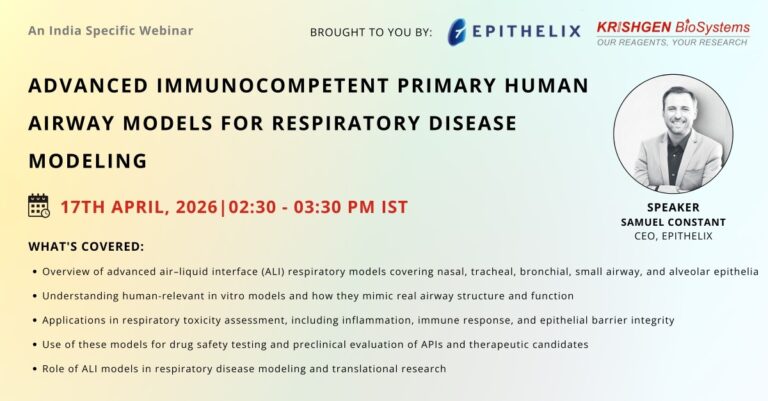
Advancements in human-relevant in vitro models are transforming how respiratory diseases are studied and how drug safety and efficacy are evaluated. This webinar will introduce a comprehensive panel of advanced air–liquid interface (ALI) primary human airway models that closely replicate the physiology of the human respiratory tract.
Covering multiple regions including nasal, tracheal, bronchial, small airway, and alveolar epithelia, these models provide a powerful platform for studying respiratory biology, disease mechanisms, and inhalation toxicology. The session will also explore how co-culturing with immune cells enhances physiological relevance, enabling more predictive and translational outcomes.
Join this session to understand how next-generation airway models are supporting drug discovery, reducing reliance on animal testing, and improving the accuracy of preclinical research.

Speaker: Dr. Samuel Constant, Co-Founder and CEO | Epithelix
Dr. Samuel Constant, Ph.D., is the Co-Founder and Chief Executive Officer of Epithelix, where he leads the company’s global management, strategic direction, business development, and partnerships across its Swiss and French operations.
A synthetic organic chemist by training, Dr. Constant has over 20 years of international research experience, having worked across Switzerland, France, the United Kingdom, and Japan. He has extensive expertise in in vitro test method development, particularly in the advancement of human-relevant respiratory models for biomedical research and drug development.
Dr. Constant has co-authored more than 150 scientific publications and has received 18 awards recognizing his contributions to scientific research, technological innovation, and business development. His work continues to support the development of advanced in vitro models that improve translational research and reduce reliance on animal testing.
Key Learning Objectives
- Overview of advanced air–liquid interface (ALI) respiratory models covering nasal, tracheal, bronchial, small airway, and alveolar epithelia
- Understanding human-relevant in vitro models and how they mimic real airway structure and function
- Applications in respiratory toxicity assessment, including inflammation, immune response, and epithelial barrier integrity
- Use of these models for drug safety testing and preclinical evaluation of APIs and therapeutic candidates
- Role of ALI models in respiratory disease modeling and translational research
Who Should Attend?
- Researchers and scientists in pharmaceutical and biotechnology companies
- Professionals working in CROs
- Academic researchers in respiratory biology and life sciences
- Experts in inhalation toxicology and drug delivery
- Scientists involved in in vitro model development and preclinical research
Benefits of Attending:
- Gain insights into cutting-edge human airway models and their real-world applications
- Understand how to improve predictive accuracy in respiratory research
- Learn strategies to enhance drug safety and efficacy evaluation
- Explore alternatives that reduce dependence on animal testing
- Stay updated with the latest advancements in translational respiratory research