
Viral Vectors & CRISPR for Building Disease Models
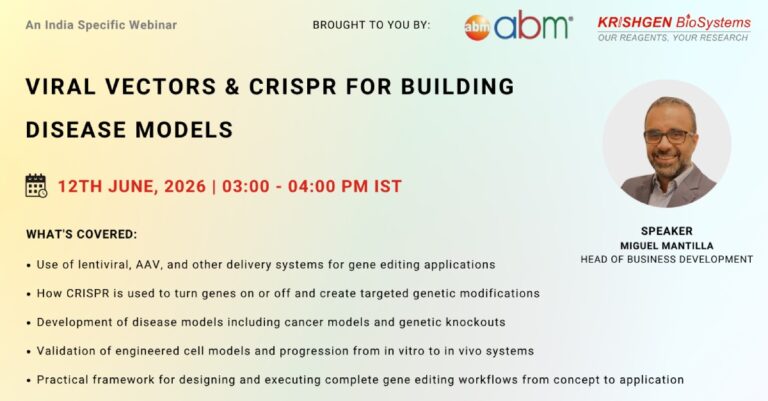
Gene editing and viral vector technologies are transforming the development of advanced disease models for translational research. This webinar will provide practical insights into how lentiviral, AAV, and other delivery systems are used alongside CRISPR technologies to create targeted genetic modifications in mammalian cells.
The session will cover the development of engineered disease models, including cancer models and genetic knockouts, along with strategies for validating edited cell systems and advancing from in vitro studies to in vivo applications. Through real-world examples, attendees will gain a clearer understanding of complete gene editing workflows, from experimental design to practical application.
Join this session to understand how CRISPR and viral vector technologies are enabling more advanced and translationally relevant disease models for biomedical research.

Speaker: Miguel Mantilla
Head of Business Development | abm
Miguel Mantilla, MBA, PhD, is a biotechnology executive specializing in translational life sciences, gene modulation technologies, and advanced cellular engineering. He currently serves as Head of Business Development (EMEA) at Applied Biological Materials (abm), where he leads strategic expansion across Europe, the Middle East, and Latin America, focusing on the deployment of CRISPR-based systems, viral vector platforms, and engineered cell models into academic and biopharma research environments.
He holds an MBA from Esden Business School, an MSc in Molecular Biology from the University of Buenos Aires, and a PhD in Neuroscience from the Weizmann Institute of Science, with a research background rooted in neurobiology, systems neuroscience, and cellular signaling. His work integrates molecular and cellular neuroscience with industrial biotechnology, with emphasis on RNA biology, gene regulation, and platform technologies enabling functional disease modelling and translational research.
Key Learning Objectives:
- Use of lentiviral, AAV, and other delivery systems for gene editing applications
- How CRISPR is used to turn genes on or off and create targeted genetic modifications
- Development of disease models including cancer models and genetic knockouts
- Validation of engineered cell models and progression from in vitro to in vivo systems
- Practical framework for designing and executing complete gene editing workflows from concept to application
Who Should Attend?
- Researchers, scientists, and professionals working in molecular biology, cell biology, gene editing, CRISPR, viral vectors, and functional genomics
- Biopharma and biotechnology professionals engaged in disease modelling and therapeutic development
- Academicians and students in life sciences, biotechnology, and biomedical research
- Researchers working in oncology, neuroscience, and translational medicine
- CROs and laboratory professionals involved in advanced cell model development and validation
Benefits of Attending:
- Learn practical applications of CRISPR and viral vector technologies
- Understand disease model development and validation workflows
- Gain insights into in vitro and in vivo gene editing strategies
- Explore real-world applications in therapeutic and translational research